Flexible packaging continues to be one of the fastest-evolving sectors of the global packaging industry. As manufacturers respond to changing consumer expectations, stricter sustainability targets and increasing regulatory requirements, the demand for innovative materials and coating technologies has never been greater.
With the global flexible packaging market valued at over US$300 billion, investment in research and development is accelerating across every region. Manufacturers are focused on creating packaging that is lightweight, durable and functional while reducing environmental impact and improving recyclability.
A Global Market Focused on Innovation
The Asia-Pacific region remains the largest market for flexible packaging, driven by rapid urbanisation, manufacturing growth and increasing consumer demand. North America continues to experience significant growth through investment in sustainable packaging solutions and e-commerce, while Europe continues to lead the way in developing packaging that supports circular economy initiatives.
Although regional priorities may differ, manufacturers worldwide face many of the same challenges: producing packaging that protects products, extends shelf life and meets increasingly demanding environmental standards.
The Importance of Barrier Performance
The primary function of flexible packaging is to protect its contents throughout transportation, storage, retail display and consumer use. For food, pharmaceutical and other sensitive products, maintaining product integrity is essential.
Barrier coatings play a critical role by protecting products against moisture, oxygen, grease, UV light and other environmental factors that can reduce shelf life or compromise quality.
Effective barrier technologies help to:
- Extend product shelf life.
- Reduce food waste.
- Prevent contamination.
- Preserve flavour, aroma and nutritional value.
- Improve product performance while supporting recyclable packaging designs.
For some products, barrier performance works in both directions. Coffee and tea packaging, for example, must not only prevent oxygen entering the pack but also retain the product’s natural aromas and flavours.
Balancing Performance with Sustainability
As sustainability becomes a central focus across the packaging industry, material selection has become increasingly complex.
Paper-based packaging is often viewed as a sustainable alternative to plastic, but achieving the required barrier performance frequently requires additional functional coatings. Materials such as EVOH can provide excellent oxygen barriers but may require further protective layers to resist moisture, adding complexity to recycling processes.
The challenge for manufacturers is to achieve the right balance between performance, processability and end-of-life recyclability without compromising product protection.
Bio-Based Coatings and Renewable Materials
One of the most exciting areas of development is the growth of bio-based and renewable coating technologies.
Materials derived from natural sources, including polysaccharides, proteins and lipids, are attracting significant interest due to their potential to deliver high-performance barrier properties while reducing environmental impact.
Research is also expanding into innovative renewable materials such as seaweed, agar and carrageenan. These formulations present unique coating challenges because of their high water content and specialised drying requirements, making pilot-scale development essential before commercial production.
From Laboratory Trials to Commercial Production
Developing new coating formulations requires equipment capable of accurately replicating production conditions while using only small quantities of material.
Pilot coating systems allow manufacturers to evaluate multiple coating methods, optimise drying parameters and validate performance before committing to full-scale manufacturing. This significantly reduces development costs, shortens project timescales and provides greater confidence when introducing new products.
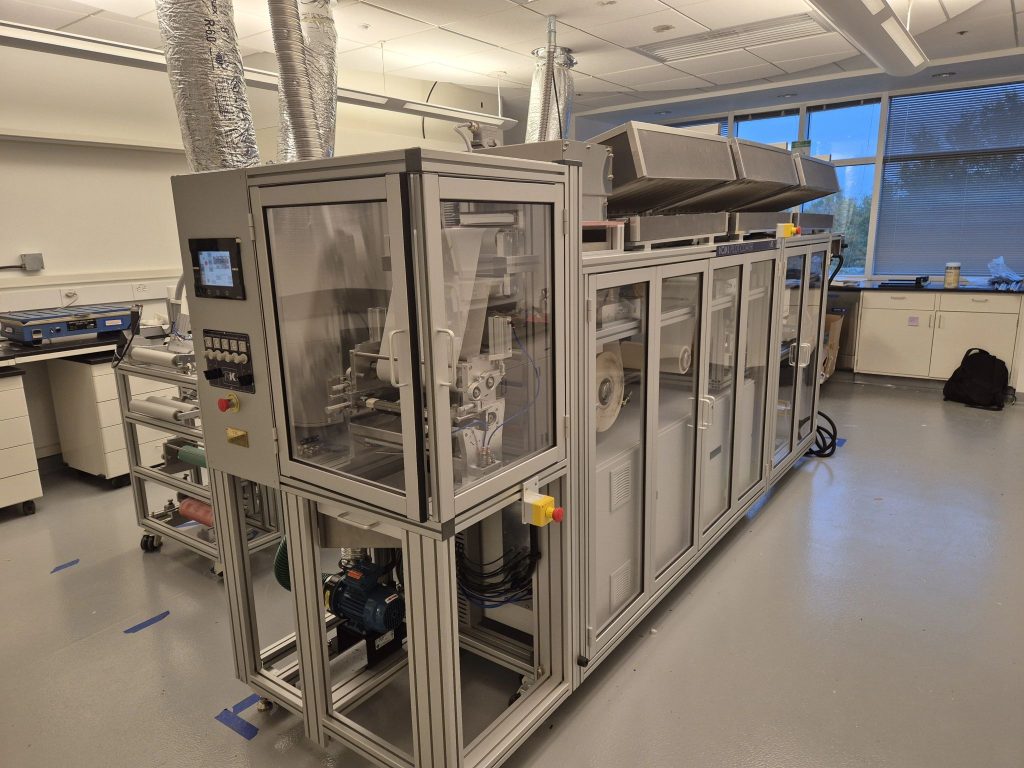
The RK Print VCML Pilot Coater has become an important development platform for companies working in flexible packaging, offering a range of interchangeable coating and printing technologies including direct and reverse gravure, slot die, flexographic coating and knife-over-roll applications. Its ability to laminate using pressure-sensitive adhesives further expands its development capabilities.
Accelerating Product Development
As demand for sustainable flexible packaging continues to grow, manufacturers need development equipment that bridges the gap between laboratory research and commercial production.
Pilot coating systems enable researchers and product developers to evaluate multiple coating methods, optimise drying parameters and validate performance using minimal quantities of material. This reduces development costs, shortens project timescales and provides greater confidence when scaling up to full production.
The RK Print VCML Pilot Coater offers a range of interchangeable coating and printing technologies, including direct and reverse gravure, slot die, flexographic coating and knife-over-roll applications. Its modular design allows manufacturers to simulate commercial coating processes in a controlled laboratory environment, helping to accelerate innovation while reducing development risk.
Looking Ahead
As the flexible packaging industry continues to evolve, innovation in materials, coating technologies and manufacturing processes will remain essential. Manufacturers are increasingly seeking solutions that deliver exceptional product protection while supporting sustainability, recyclability and production efficiency.
By providing flexible pilot coating systems that accurately replicate production processes, RK Print helps manufacturers develop, refine and validate new products with confidence, enabling faster innovation and a smoother transition from laboratory development to commercial manufacture.